
If you want to drive the biggest rigs on the road, you’re after the Multi-Combination (MC) licence. We’re talking B-doubles and road trains here. It’s the top of the food chain in the transport industry.
Getting your MC ticket opens the highest-paying driving jobs in the country. It allows you to legally drive a prime mover towing more than one trailer. This includes B-doubles (common on the Pacific Highway) and road trains (common in mining and outback runs).
But you can’t just walk in off the street and get one. There’s a process, and you need some experience under your belt first. Here is exactly how it works.
First, do you qualify?
Unlike a standard car licence, you can’t go for your MC as your first heavy vehicle licence. You need to work your way up.
In New South Wales, the rules are strict. To be eligible to upgrade to an MC licence, you must:
- Have held a Heavy Rigid (HR) or Heavy Combination (HC) licence for at least one year.
- Pass the relevant eyesight test.
- Pass the MC knowledge test (DKT) at Service NSW.
If you’re currently driving a car or a Light Rigid truck, you’ve got a bit of work to do before you can look at the MC. Most drivers start with their HR to get the hang of the size and weight, get a year of experience, and then make the jump.
Why bother upgrading?
Simple: Demand and pay.
There is a massive shortage of qualified MC drivers in Australia right now. Handling a B-double requires more skill than a standard rigid truck, especially when you’re trying to reverse the thing. Because it’s harder to drive, companies pay a premium for that skill.
If you’re looking to get into interstate linehaul or fly-in-fly-out (FIFO) mining work, the MC licence is usually non-negotiable.
The Process: How to get the ticket
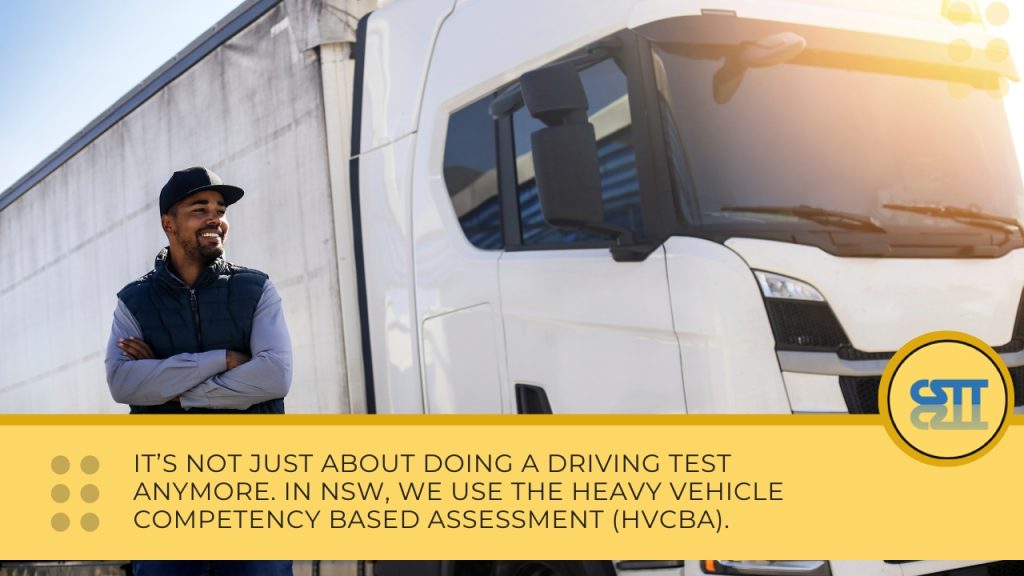
It’s not just about doing a driving test anymore. In NSW, we use the Heavy Vehicle Competency Based Assessment (HVCBA).
This means you don’t have one high-pressure test at the end with a terrifying examiner. Instead, you’re trained and assessed on specific criteria as you go. It’s a much better way to learn because we can focus on the bits, you’re finding tricky until you get them right.
Here is the step-by-step:
- Go to Service NSW – Pass the “Combination” Driver Knowledge Test (DKT). It’s multiple choice. Once you pass, they give you a HVCBA Logbook.
- Book your training – This is where we come in. You bring your logbook to us.
- The Training – We take you out in the vehicle. We’ll cover starting, steering, braking, and the tricky stuff like coupling/uncoupling trailers and reversing.
- The Assessment – Once you’re competent, we sign off on your logbook.
- Get the Licence – Take the signed certificate back to Service NSW, pay the fee, and they update your licence.
A note on gearboxes
This catches a few people out. If you currently hold an automatic-only licence, and you do your MC assessment in an automatic (or synchromesh) gearbox, you will still be restricted to automatics.
If you want the “open” or “unrestricted” licence which lets you drive the Road Ranger crash boxes, you usually need to demonstrate you can use the clutch properly. If you already have an unrestricted HR or HC, that condition usually carries over. It’s still worth checking your current licence conditions before booking though.
Ready to make the move?
Driving a B-double is a different beast to a rigid truck. The vehicle is longer, it bends in two places, and it requires a lot more forward planning when you’re entering roundabouts or turning at intersections.
We run driving classes that take you from “I think I can do this” to “I’m confident handling 60 tonnes.”
We’ll make sure you know how to handle the vehicle safely, not just how to pass the assessment.
If you’ve done your year on a HR or HC and you’re ready to step up to the big leagues, give us a call, we can check your eligibility and get you booked in. Call us on 0434 366 758.